


AST 5P Signal Transmitter
A strain gauge load cell produces a tiny, fragile millivolt signal — far too weak and too noisy for a PLC or DCS to read reliably. Long cable runs, electrical interference, and drift only make it worse. You need that signal amplified, conditioned, and converted into a stable industrial output before it reaches your control system.
The BLH Nobel AST 5P does exactly that. As a compact DIN rail mounted load cell signal transmitter, it converts the output of connected strain gauge transducers into a highly stable, accurate signal suitable for PC and PLC based control systems. At its heart is a high-accuracy A/D converter with 24-bit internal resolution and excellent long-term stability, delivering rapid-response measurement you can trust.
It speaks both worlds at once: a precise analog signal transmitter output (±10 VDC / 4-20 mA) for direct wiring into a PLC analog input, and RS-485 Modbus RTU for digital integration. And because the AST 5P is engineered as a direct AST 3P replacement, existing users can upgrade without re-engineering their installation.
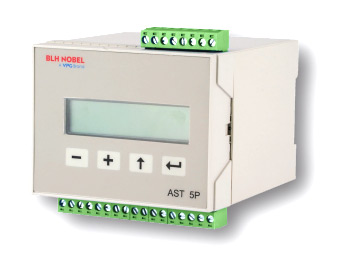
INTERNAL RESOLUTION
ANALOG OUTPUT
RELAY RESPONSE
LOAD CELLS (350 Ω)
A Direct Replacement for the AST 3P
Upgrade to the AST 5P without altering your existing system. It keeps the same compact DIN rail format and is configured with the Windows-based deltaCOM software. Set-up data is stored on the host PC and downloaded to the new unit, so transmitter swaps are fast and your prior investment is protected.
Core Features Built for Industrial Control
Every capability is aimed at one job: getting an accurate, stable load measurement into your control system reliably, in demanding industrial conditions.
- 24-bit internal conversion High-accuracy A/D converter with 24-bit internal resolution and <0.005% non-linearity for stable, repeatable readings over long cable runs and temperature.
- Flexible analog output 16-bit current/voltage output: 0-10 / ±10 VDC, 0-20 mA, ±20 mA, 4-20 mA or -12 to 20 mA — a true 4-20 mA load cell output transmitter that wires straight into a PLC analog input.
- RS-485 Modbus RTU Isolated RS-485 (two- or four-wire) running Modbus RTU or ASCII at up to 115.2 kbaud — a clean load cell to PLC transmitter path for digital control or an external display.
- Dual relay outputs (<20 ms) Two relay outputs (max 1 A, 30 VAC/VDC) with sub-20 ms response drive valves, feeders or alarms for high-precision level control — a load cell transmitter with relay outputs built in.
- Up to 8 load cells ±5.1 V excitation drives up to 8 × 350 Ω strain gauge load cells (total load >45 Ω), so a single transmitter conditions a full multi-cell tank, silo or platform.
- Easy configuration Set up and calibrate from the front-panel LCD and keypad, or via the Windows-based deltaCOM software. Two digital inputs add remote control of common functions.
- Industrial build DIN 46277 / DIN EN 50022 mounting in a compact 75 × 100 × 110 mm housing, plug-in screw terminals, IP20, CE marked and FCC approved.
- Proven lineage The next generation of a trusted transmitter family, from a pioneer in process weighing with 60+ years of experience and systems installed in more than 100 countries.
Technical Specifications
Key specifications as published in the AST 5P datasheet (Document No. 12301).
|
|
|
|
|
|
|
|
|
|
|
|
|
|
|
|
|
|
|
|
|
|
|
|
|
|
|
|
|
|
|
|
|
|
|
|
|
|
|
|
|
|
|
|
|
|
|
|
Industry Applications
Wherever a strain gauge load measurement has to reach a control system reliably, the AST 5P fits — as a weight transmitter for process control across demanding industries.
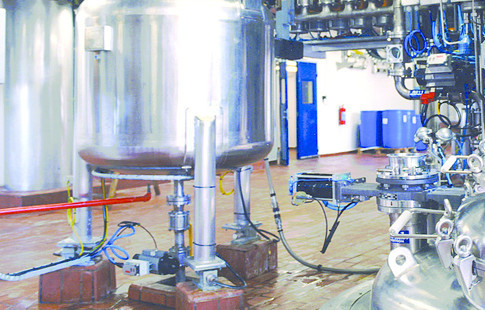
Process control systems
Feed accurate, conditioned weight and force signals into PC and PLC based process control.

High-precision weighing
Stable 24-bit conditioning for tanks, silos, hoppers and platform scales built on multiple load cells.

Industrial automation
Reliable analog and Modbus RTU signals for automated lines, machines and material handling.

Level monitoring
Continuous level and inventory readings from vessel-mounted load cells, by weight rather than by surface sensing.
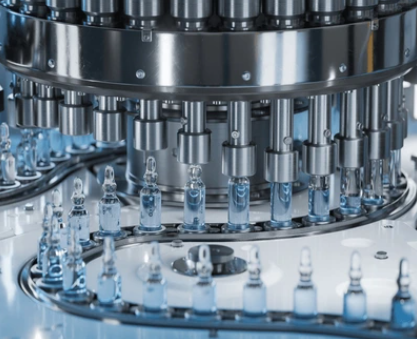
Quality control systems
Dependable measurement data for in-line checking and process verification.

Setpoint & dosing control
Sub-20 ms relay outputs drive valves and feeders for accurate fill, dose and cutoff control.
Application in focus: high-precision level control on a process vessel
Consider a mixing or storage vessel supported on multiple strain gauge load cells, where contents must be held between accurate high and low thresholds. The cells’ combined millivolt signal is conditioned by a single AST 5P, which streams a stable 4-20 mA reading to the plant PLC and, in parallel, uses its two sub-20 ms relay outputs to drive the fill and discharge valves directly as each level threshold is crossed. The result is tight, repeatable level control with minimal added wiring — drawn straight from the conditioned load cell signal.
Questions, Answered
Is the AST 5P a direct replacement for the AST 3P?
Yes. The AST 5P is engineered as a direct replacement for the AST 3P, so you can upgrade without altering your existing system. It keeps the same compact DIN rail format and is configured with the Windows-based deltaCOM software. Because set-up data can be stored on the host PC and downloaded to a new unit, swapping a transmitter is quick and your prior investment is protected.
How do you convert a load cell signal to a 4-20 mA output for a PLC?
A load cell outputs a small millivolt signal a PLC can’t read directly. A signal transmitter like the AST 5P amplifies and conditions that strain gauge signal and converts it into a standard process signal. The AST 5P provides a 4-20 mA output (as well as 0-20 mA, ±20 mA, -12 to 20 mA, or 0-10 / ±10 VDC) that wires straight into a PLC analog input, plus RS-485 Modbus RTU for digital integration.
Which DIN rail transmitter works with strain gauge load cells and supports Modbus RTU?
The BLH Nobel AST 5P is a DIN rail mounted transmitter designed for strain gauge transducers and load cells. It communicates over RS-485 (two- or four-wire) using the Modbus RTU protocol at up to 115.2 kbaud, alongside its analog outputs, making it straightforward to integrate with a PC or PLC based control system.
How many load cells can one signal transmitter handle?
A single AST 5P drives up to 8 × 350 Ω load cells, provided the total combined load stays above 45 Ω, using its ±5.1 V excitation. That lets one transmitter condition the summed signal from a multi-cell tank, silo or platform installation.
What is the best load cell signal conditioner for high-precision level control?
For high-precision level and setpoint control, look for fast relay response and stable conditioning. The AST 5P pairs 24-bit internal resolution and <0.005% non-linearity with two relay outputs that respond in under 20 ms, so it can drive valves, feeders or alarms accurately as a level threshold is crossed — directly from the conditioned load cell signal.
What is the difference between a signal transmitter and a weighing indicator?
A signal transmitter such as the AST 5P is built to condition a strain gauge load cell signal and send it to a control system as a stable analog (4-20 mA / ±10 VDC) and serial (RS-485 Modbus RTU) output; its compact LCD is mainly for local set-up and readout. A weighing indicator or process instrument is a larger operator-facing device focused on display, multi-function control and operator interaction. In short: a transmitter feeds the PLC, while an indicator presents and controls the process at the panel.
Specify the AST 5P for Your Application
Whether you’re upgrading from an AST 3P or integrating new load cells into a PC or PLC control system, our application engineers will help you configure the right outputs, communication, and calibration — and support you through installation and beyond.
Contact BLH Nobel or download the AST 5P datasheet for full specifications.