


LCAMP Transmitter
ATEX & IECEx approved · Two-wire 4–20 mA output · Field-replaceable without recalibration
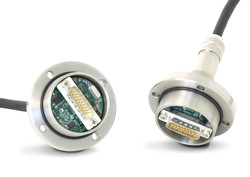
When a single failed measurement can stop a crane, halt a winch, or compromise a mooring line offshore, the electronics inside your load cell matter as much as the sensor itself. The BLH Nobel LCAMP transmitter family is a range of embedded HART load cell transmitters engineered to turn a load cell’s low-level millivolt signal into a rugged, noise-immune 4–20 mA loop — and to keep doing it for decades in salt spray, vibration, and temperature extremes.
Designed to be embedded directly in the load cell, the LCAMP series removes the weak link in long-cable installations: instead of carrying a fragile mV/V signal across a hazardous area, you transmit a robust current signal with full HART diagnostics, in single or redundant configurations. The result is reliable force measurement where downtime is expensive and access is difficult — the conditions BLH Nobel has been building for since 1967.
Why Engineers Choose the LCAMP Transmitter
The LCAMP family — LCAMP100, LCAMP110, LCAMP120, LCAMP130 and LCAMP300 — addresses the real pain points of force measurement in heavy industry and offshore environments:
- Two-wire 4–20 mA output with error signaling. A true two-wire load cell transmitter that powers the device and carries the measurement on the same loop, with built-in error signaling so faults are never mistaken for valid readings.
- HART 7 communication. This intrinsically safe load cell amplifier delivers system diagnostics and process data digitally over the existing 4–20 mA loop — no extra wiring for commissioning, monitoring or troubleshooting.
- ATEX and IECEx intrinsic safety (Ex ia IIC). The LCAMP110/120/130 are IECEx load cell transmitter and ATEX-approved (Ex ia I Ma, Ex ia IIC T4 Ga, Ex ia IIIC T79 °C Da) for use in Zone 0/1/2 hazardous areas, including offshore oil & gas.
- Field-replaceable without recalibration. A field-replaceable load cell transmitter can be swapped in the field without recalibrating the transmitter or the load cell — minimizing downtime and eliminating costly site recalibration.
- Embedded design. As an embedded load cell amplifier, the LCAMP is built into the load cell body for IP67 protection (when mounted), protecting the electronics from moisture, dust and mechanical damage.
- Fast or HART-compliant response. 5 ms response time in fast mode for dynamic loads, 50 ms in HART-compliant mode — covering steady tension monitoring to dynamic lifting.
- Single or redundant outputs. Redundant configurations (LCAMP120/130) provide a second independent output for safety-critical and high-availability systems.
- Built for extremes. Wide operating range of −45 °C to +70 °C, 4 GΩ insulation resistance, and a 2000 Ω strain gauge interface — robustness designed for offshore, marine and heavy process plant.
- Flexible connectivity. M12 connector or fixed cable connection through a cable gland, with on-board linearization (up to 10-point on LCAMP100) for high end-to-end accuracy.
As a complete 4–20 mA load cell signal conditioner, the LCAMP transmitter handles excitation, amplification, filtering, linearization and conversion in one sealed unit — so your PLC, DCS or weighing instrument receives a clean, calibrated, ready-to-use signal.
Industry Applications
BLH Nobel has been developing load cells and amplifiers for offshore winch and mooring load measurement for over 50 years. The LCAMP transmitter is the electronics platform behind many of those systems.

Offshore mooring & tension monitoring
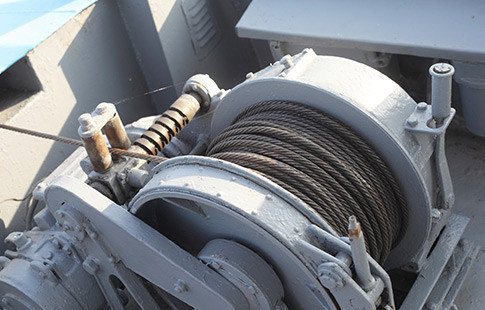
For FPSOs, CALM buoys, SPM systems and floating platforms, continuous mooring-line tension data is safety-critical. An offshore / mooring tension load cell transmitter built on the LCAMP platform delivers a stable 4–20 mA signal from load pins and tension links — even after permanent exposure to seawater — while HART diagnostics flag developing faults before they become failures.
Offshore mooring & tension monitoring
Used as a crane load monitoring transmitter, the LCAMP gives operators real-time, overload-protection-grade load data for offshore cranes, deck winches and lifting systems. The embedded, intrinsically safe design survives the same harsh conditions as the crane itself, and the field-replaceable architecture keeps lifting operations running.

Chain stoppers & mooring hooks
Quick-release mooring hooks and chain stoppers depend on accurate, certified load data in hazardous, exposed locations. The ATEX/IECEx LCAMP110/120/130 are purpose-built for these Zone 1 and 2 applications, including redundant outputs for berthing and mooring safety systems.

Heavy industrial & process force measurement
Beyond offshore, the LCAMP serves as a strain gauge signal conditioner in steel mills, mining, tank and silo weighing, and process control — anywhere a long cable run, electrical noise or a corrosive environment would otherwise degrade a raw mV/V signal.
Talk to a force-measurement engineer
Tell us about your application — capacity, environment, hazardous-area classification and output requirements — and our engineers will recommend the right LCAMP configuration, single or redundant.
- Request a quote — get pricing and lead time for your LCAMP transmitter configuration.
- Download the LCAMP datasheet (PDF) — full specifications, approvals and wiring details.
- Talk to an engineer — discuss ATEX/IECEx requirements and integration with your weighing or control system.
Frequently Asked Questions
What is a load cell transmitter and how does it work?
A load cell transmitter is the electronics that turn a load cell’s raw output into a usable industrial signal. A strain gauge load cell produces only a few millivolts per volt (mV/V) of excitation — far too small and too noise-sensitive to send across long cables to a PLC. The transmitter provides the regulated excitation voltage, amplifies and filters the signal, linearizes it, and converts it into a standardized output such as 4–20 mA. The LCAMP transmitter does all of this in a sealed unit embedded in the load cell, transmitting a robust two-wire 4–20 mA signal (with optional HART data) that downstream equipment can read directly.
How does a load cell amplifier convert a mV/V signal to 4–20 mA?
The load cell amplifier first supplies a stable excitation voltage to the strain gauge bridge. Under load, the bridge produces a small voltage proportional to force, expressed in mV/V. The amplifier conditions that signal — amplifying, filtering out electrical noise, and digitizing it — then applies calibration and linearization so the reading is accurate across the full range. Finally it scales the value to the current loop, where 4 mA represents zero load and 20 mA represents rated output. Because 4–20 mA is a current signal, it resists voltage drop and electrical interference over long cable runs, making it ideal for offshore and heavy-industrial installations.
Which load cell transmitter is suitable for ATEX/IECEx hazardous areas?
The LCAMP110, LCAMP120 and LCAMP130 are intrinsically safe, ATEX- and IECEx-approved transmitters rated Ex ia I Ma, Ex ia IIC T4 Ga and Ex ia IIIC T79 °C Da — suitable for use in hazardous areas such as offshore oil & gas, mooring and marine applications when used with the appropriate IS barrier. The LCAMP120 and LCAMP130 add redundant outputs for safety-critical systems. For non-hazardous installations, the LCAMP100 and LCAMP300 provide the same embedded, field-replaceable concept without the intrinsic-safety rating.
What is the difference between a load cell amplifier and a signal conditioner?
In practice the terms are used interchangeably — both take a low-level sensor signal and convert it into a stronger, standardized output. “Signal conditioner” is the broader term covering many sensor types, while “load cell amplifier” or “load cell transmitter” specifically describes the device used with strain gauge load cells. The LCAMP transmitter is all three: it conditions, amplifies and transmits, providing excitation, filtering, linearization and a 4–20 mA output in one device.
Can a load cell transmitter be replaced without recalibrating the load cell?
Yes. The LCAMP is a field-replaceable load cell transmitter, designed to be swapped in the field without recalibrating the transmitter or the load cell. This is a key advantage in offshore and remote installations, where sending a unit back for calibration would mean extended downtime. The replacement transmitter restores the calibrated signal immediately, keeping cranes, winches and mooring systems in service.