


PST Strip Tension Measurement System
Better than 0.1 % accuracy · 20–200 kN · Immune to thermal expansion and side loads · No adapter plates
Inside a continuous galvanizing or annealing furnace, the deflecting roller runs hot, expands, and bends — and most tension sensors read those forces as tension error. The BLH Nobel PST is a furnace strip tension measurement unit engineered specifically for that environment: a strip tension load cell system that measures the true tension the strip exerts on the roller, without being fooled by thermal growth or side loads.
Built around four standard KIS load cells in a purpose-designed arrangement, the PST delivers accuracy better than 0.1 % of maximum strip tension across the full operating range — at the high temperatures where galvanizing and annealing lines actually run. Because it uses standard load cells and is mechanically adapted to your existing bearing blocks, you get high-accuracy steel strip tension measurement without proprietary sensors, adapter plates, or costly spare parts.
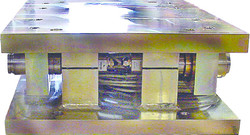
Why Process Engineers Specify the PST
The PST is designed around the realities of tension control in continuous furnace lines:
- Accuracy better than 0.1 % of maximum strip tension. A furnace strip tensiometer that stays accurate at both maximum and minimum tension — critical for strip quality, flatness, and preventing strip breaks.
- Immune to thermal expansion. Four KIS load cells in a specific arrangement make the unit insensitive to the axial forces and bending moments that thermal growth of the deflecting roller normally introduces.
- Side-load insensitive tensiometer. The mechanical design rejects side-load forces, so off-axis loading from the roller does not corrupt the tension reading.
- High-temperature strip tension sensor. Rated for −40 °C to +80 °C as standard, with a +100 °C option — built for the hot zones of continuous lines.
- Built on standard KIS load cells. As a KIS load cell strip tension unit, spare parts are low-cost, widely available standard weighing load cells — not proprietary transducers — keeping cost of ownership down.
- No adapter plates required. Each PST is custom-designed to fit your existing bearing blocks, so retrofits and new installations mount directly without machined adapter plates.
- Easy maintenance and calibration. Standard sensing elements and a serviceable mechanical design make routine calibration and maintenance straightforward, even mid-campaign.
- Five capacities. Available in 20, 40, 80, 120 and 200 kN to match your line, with 2 mV/V rated output and a shielded four-conductor cable or connector.
As a complete web tension measurement system, the PST connects to BLH Nobel transmitters, junction boxes and process instruments — giving your control system a clean, accurate tension signal over the fieldbus you already run.
Where the PST is Used
For more than 50 years, BLH Nobel has built force-measurement solutions for the metals industry. The PST applies that experience to one of the most demanding measurement points on a continuous line: inside the furnace.
- Continuous hot-dip galvanizing lines
On a continuous galvanizing line, strip tension governs coating uniformity, strip tracking, and the prevention of creasing and breaks. As a hot-dip galvanizing strip tension sensor, the PST provides stable, high-accuracy continuous galvanizing line strip tension data directly from the furnace deflecting roller — so operators can hold tension within range during both acceleration and deceleration. - Continuous annealing lines
In continuous annealing, the strip is softest in the soaking section, where tension control is most critical. The PST enables precise continuous annealing line tension measurement at elevated temperatures, helping flatten cold-rolling shape defects through controlled elongation while protecting against over-necking and strip breaks. - Retrofit and line upgrades
Because the PST is built on standard KIS load cells and adapts to existing bearing blocks, it is an effective upgrade path for older lines. A typical installation — for example, a PST-80 kN mounted under a furnace roller — replaces or upgrades legacy tension measurement without re-engineering the roller support or adding adapter plates. - Multi-zone tension control
As a tension measuring roller load cell solution, the PST can be applied at multiple deflecting rollers along the line, feeding zone-by-zone tension data to the control system for stable, repeatable strip handling from entry bridle to exit.
Specify the Right PST for your Line
Tell us your line type, strip dimensions, tension range, roller geometry and bearing-block details — our application specialists will design a PST that fits your installation and prepare the mechanical solution for your line.
- Request a quote — get pricing and lead time for your PST configuration and capacity.
- Download the PST datasheet (PDF) — full specifications, capacities and outline dimensions.
- Talk to an application engineer — discuss roller geometry, furnace temperature and integration with your tension control system.
Frequently Asked Questions
What is a strip tension measurement system and how does it work?
A strip tension measurement system determines the tension in a moving strip by measuring the force the strip exerts on a deflecting (measuring) roller as it is pulled over it. Load cells mounted under the roller’s bearing blocks sense the resultant force; because the strip’s wrap angle over the roller is known or controlled, that force is converted into an accurate tension value. The PST is a complete system of this type: four KIS load cells sense the force at the furnace roller, and a BLH Nobel transmitter converts the signal into a tension reading for your control system.
How is strip tension measured inside a continuous galvanizing or annealing furnace?
The strip runs over a deflecting roller inside the furnace, and the PST measures the force that the tensioned strip applies to that roller. The challenge unique to the furnace is heat: the roller and its supports expand and bend at process temperature. The PST is mounted under the roller’s bearing blocks and uses an arrangement of four load cells that cancels the forces created by that thermal growth — so it reads true strip tension at temperatures up to +80 °C (or +100 °C as an option), where galvanizing and annealing lines operate.
How do you measure strip tension without errors from thermal expansion and side loads?
The PST uses four standard KIS load cells arranged so that the axial forces and bending moments induced by the deflecting roller’s thermal expansion cancel out rather than appear as tension error. The same mechanical design makes the unit insensitive to side-load forces. The result is a side-load insensitive tensiometer that stays accurate even as the roller grows and shifts with temperature — the main source of error in conventional furnace tension measurement.
What accuracy can a furnace strip tensiometer achieve?
The PST achieves accuracy and repeatability better than 0.1 % of maximum strip tension across its range, at both maximum and minimum tension. In a configuration using one dummy load cell, accuracy is better than 0.5 % of rated output. This level of performance is what allows tight, repeatable tension control on galvanizing and annealing lines.
Can a strip tension unit be retrofitted to existing furnace bearing blocks without adapter plates?
Yes. Each PST is custom-designed to match your existing bearing blocks, so it mounts directly without machined adapter plates — whatever the strip tension profile or the mechanical mounting of the measuring roller. Because the sensing elements are standard KIS load cells, retrofits also benefit from low-cost, readily available spare parts and easy maintenance.